If you’re using Google Search Console to track SEO performance, you will have noticed that from September 12th, 2025, there was an obvious drop in impressions and a large change in average position. You might see something like this (purple line represents impressions, blue line represents clicks):
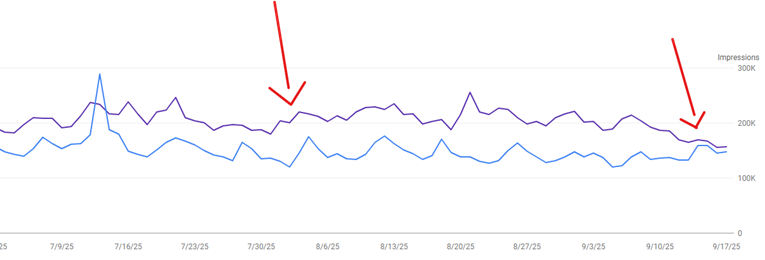
The first red arrow is what we’ve all typically been seeing, where impressions are far higher than clicks. Something which the industry was calling “decoupling” due to, what was originally thought to be the cause from AI overviews and AI Mode, not sending as many clicks to websites.
However, the 2nd arrow points to the 12th September, 2025, where impressions are now much lower.
The same can be seen for average position. A high increase on September 12th
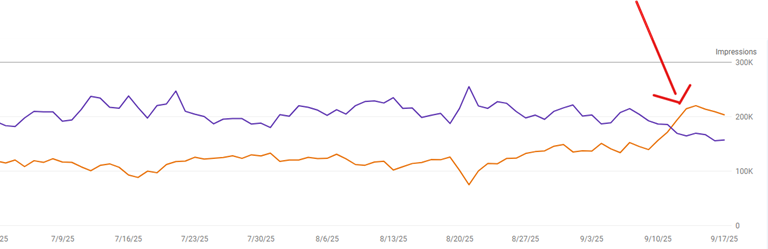
So what has happened? Was there a major Google algorithm update? No. Its something much different
Third party tools accessing Google search results
There are many third-party tools that access Google’s search results every day. Visibility platforms like Ahrefs and SEMrush, for example, scrape Google results (i.e., extract ranking data) to see which pages appear for certain search terms. Similarly, large language model (LLM) providers such as OpenAI, Perplexity, and others also query Google regularly. All of this activity is classified as “bot traffic”; traffic generated by software rather than humans.
While scraping has always been against Google’s terms of service, the company has historically tolerated it. Traditionally, these vendors could retrieve the top 100 results for a search query in a single request. For instance, if they wanted results for the keyword “blinds”, they could access all 100 listings (pages 1 through 10) at once.
Recently, however, Google disabled the ability to pull 100 results in one request. Now, vendors must run 10 separate queries to gather the same 100 results. This shift significantly increases computing demands and operational costs.
As a result, far fewer third parties are scraping search results as extensively as before, which has led to a noticeable reduction in bot traffic
So tell me again, how does this relate to the drop in impressions?
In the image below, the red line shows where third-party tools were able to extract information for the first 100 search results in 1 go. Blue line shows where they are no longer able to do this in 1 go.
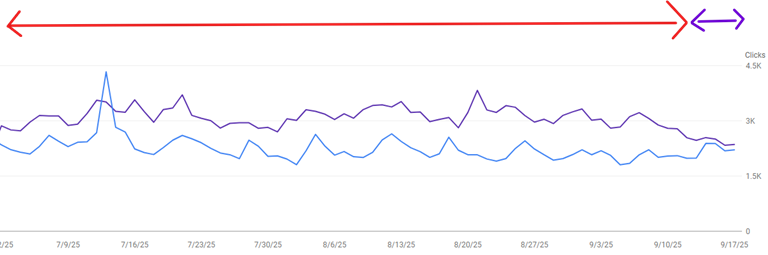
Because third-party tools can’t extract the data so easily, they are reducing the number of times they are “scraping” this information from Google search results.
So the extra impressions were from third-party tools, not users?
Yes, this is what the consensus is. The huge amount of scraping of Google search results, would have triggered an “impression”, so were in fact inflating the impression data by some margin. The improved in average position which I mentioned earlier, is all down to far fewer impressions being generated beyond page 1 and 2.
Don’t be alarmed by the drop in impressions; its now probably a much more accurate view. But, this doesn’t take away the fact that clicks are reportedly being lost through AI overviews…